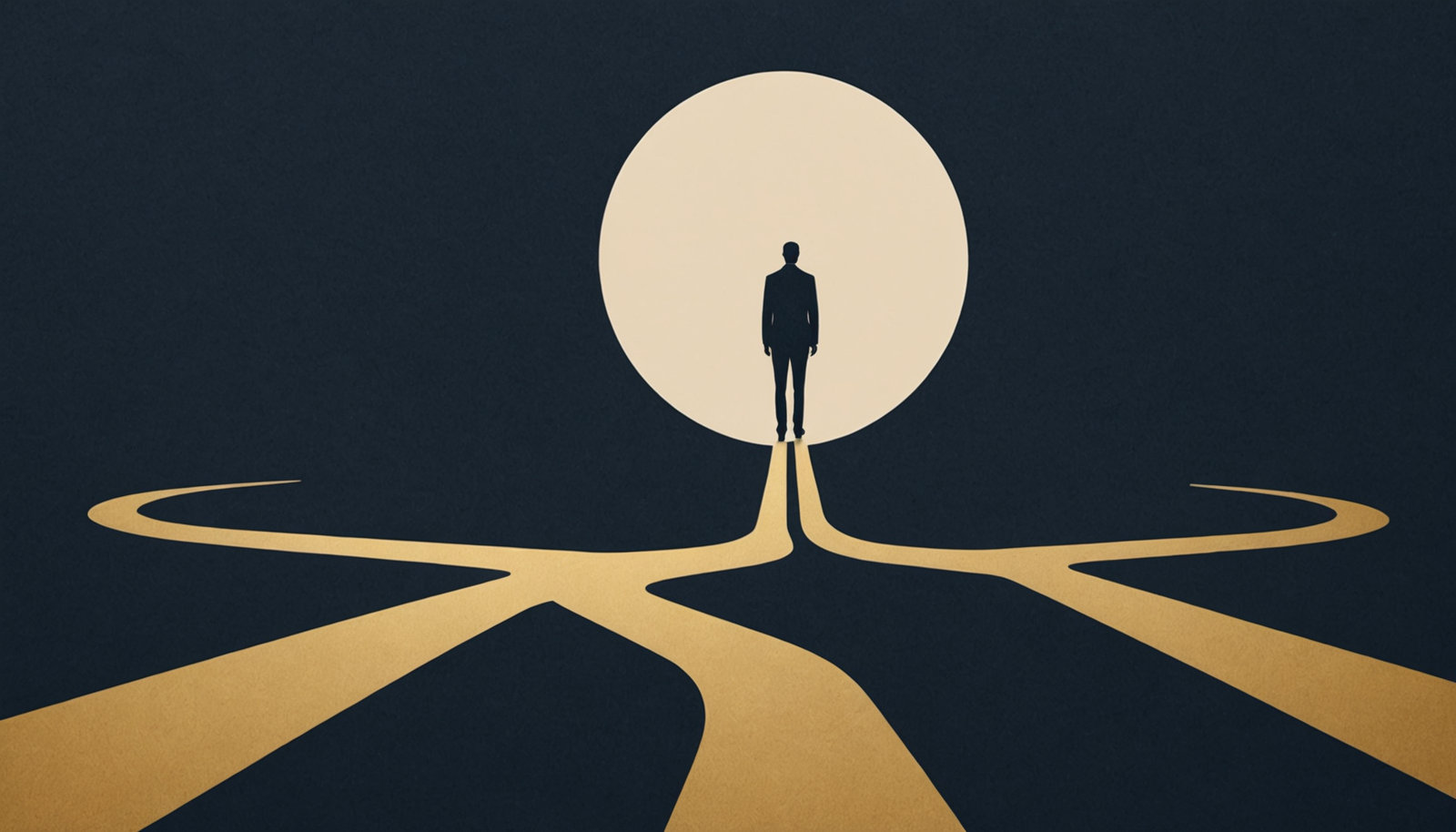
That panicked paralysis, the one that grips you in the stomach, can last ten minutes or ten years.
In the executive offices at the top of your head, the mind has already finished its report. It has already reached a decision.
Sometimes it says you should commit. Sometimes it rules that you should cut.
If we totalled up the weeks, the months and the years that people have wasted before executing a decision that had already ripened in their hearts, we would arrive at a very large number indeed.
Human existence is chaos. Our psyche and the psyches of those around us are chaos. Even tomorrow is a square of chaos, rich in uncertainty.
In a consumer world that tries to remove from us every shred of doubt, every unnecessary moment of waiting, every possible source of frustration, the denial of the chaotic element in human fate makes the need to decide far harder.
But you have to decide, otherwise you will suffer bitterly.
So why do you freeze rather than take the right step?
I can think of three main reasons.
One. The wish to avoid pain.
Say what you like about the current situation in your life — it has not killed you yet. Whereas a decision introduces a fresh, sharp, identifiable pain with a date attached, and the mind reliably prefers a chronic ache of unknown total cost to an acute one of known size.
Two. The loss is concrete and the gain is hypothetical.
What you give up is specific and can be pictured. What you obtain is a description of a possible future. Those two are not weighed on the same scale, and the imbalance is structural rather than a failure of nerve.
Three. As long as you have not decided, you have not been wrong.
An undecided person retains the possibility of having been right all along. A decision converts you into someone who can be judged, including by yourself — and a great many people will pay years for that exemption without ever noticing the invoice.